.svg)





.png)
.avif)
Many people use the words brand refresh and rebrand interchangeably, but they represent two very different levels of change. A brand refresh is similar to giving your brand a makeover. It adjusts and updates your existing identity while keeping the core of the brand intact. A rebrand, on the other hand, is a complete transformation that can include reinventing your name, message, values, visuals, and even your place in the market.
Understanding the differences between these two approaches is essential, as choosing the wrong path can waste time, money, and effort. A brand refresh is the right choice when your brand simply needs a modern, polished look. A rebrand becomes necessary when your current identity can no longer support your long-term goals or fails to connect with the customers you want to reach. Let’s look at these branding terms in detail.
What is a Brand Refresh
A brand refresh updates your current brand without replacing the entire foundation. Think of it as revitalizing the visual and verbal elements of your brand to appear more relevant and appealing. You do not throw away your history. You simply give it new life.
A brand refresh often includes updated colors, revised logo proportions, new photography styles, clearer messaging, and slight modifications to the tone of communication. It is meant to be subtle but effective. Customers will still recognize your brand, but it will appear sharper, more modern, and more aligned with current expectations.
A refresh allows companies to stay current in fast-changing industries where design and communication standards evolve quickly. It is ideal when your brand feels a little tired or stale but still carries meaningful recognition and loyalty.
Signs Your Brand Might Need a Refresh
A brand does not lose relevance overnight. It fades slowly, and several warning signs often appear before the damage becomes serious. Below are the most common signals that you might need a brand refresh.
Your visuals look outdated
If your design choices reflect older style trends, they may create the impression that your company is lagging behind. Modern audiences expect visually fresh experiences.
Your audience has evolved
If the people you serve have changed in age, values, location, or preferences, the brand must adjust to match their expectations.
Competition seems more modern
If competitors appear more innovative and current, your brand may lose market share simply because it looks old.
Your messaging is inconsistent
Over time, companies often accumulate scattered messages, different taglines, and conflicting tones. A refresh aligns everything.
You want to show progress without starting over
A refresh is a great way to signal improvement or evolution while keeping your underlying identity intact.
What is Involved in a Brand Refresh
A brand refresh touches many elements of your brand but does not replace the entire structure. The goal is to modernize while preserving brand recognition. A refresh may involve:
1. Updated visual identity - New color palette, refined typography, updated logo style, and improved layout choices.
2. Enhanced brand voice - Clearer tone, simpler phrasing, stronger emotional connection, and more consistent messaging across platforms.
3. Revised brand guidelines - Rules for using visuals, writing style, photography, illustrations, and layouts.
4. Digital presence updates - Fresh website design, improved social media styles, updated imagery, and a more responsive user experience.
5. Customer experience adjustments - New packaging, more modern email templates, and improved communication at every touchpoint.
A refresh usually takes less time and investment than a rebrand. It is also less disruptive for your audience.
Brand Refresh Examples
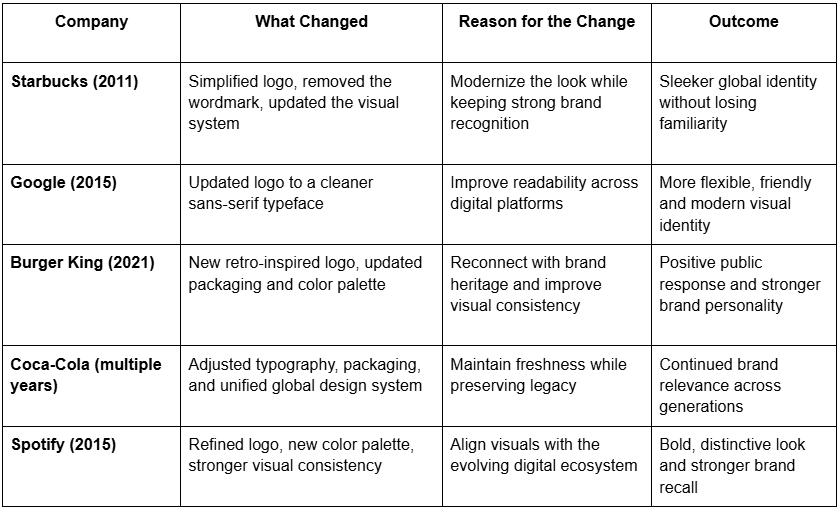
Pros and Cons of a Brand Refresh
A brand refresh can breathe new life into your business, but it is not a one-size-fits-all solution. Understanding the advantages and limitations will help you decide whether it is the right move for your organization.
Pros
- Cost-effective: A refresh updates your logo, color palette, and other brand elements without the major expenses of a full rebrand. It’s ideal for companies with limited budgets that still want a modern look.
- Low risk: Since it doesn’t drastically change your brand identity, loyal customers continue to recognize and trust your brand, reducing the risk of confusion or alienation.
- Quick to implement: Refreshes can be completed in weeks or months, letting your brand adapt quickly to trends, competitor changes, or evolving customer expectations.
- Preserves brand equity: Enhances your brand’s visual appeal while keeping the recognition, loyalty, and value you’ve built over time intact.
- Improves market relevance: Modernizes your messaging and visuals to stay current without abandoning your brand’s history, helping you maintain audience interest.
Cons
- Limited impact on deeper issues: A refresh can’t solve problems like declining customer trust, negative reputation, or unclear brand positioning.
- May not stand out: In fast-changing industries, subtle updates may leave your brand looking outdated if competitors are undergoing bold transformations.
- Doesn’t solve structural problems: A refresh addresses appearance and messaging, but cannot realign your brand’s name, positioning, or overall strategy if they no longer fit your business goals.
What is a Rebrand
A rebrand is a full reconstruction of your brand identity. It does not simply adjust details. It creates a completely new expression of who you are. A rebrand may include a new name, new values, new visual identity, new brand message, and even a new mission statement.
.png)
Rebranding is often necessary when a company has outgrown its original identity, when major changes occur inside the business, or when the existing brand has lost relevance or trust. A rebrand is a powerful strategic shift that can significantly alter how the market perceives the organization.
When is a Rebrand the Right Move
A rebrand is usually needed in situations where a refresh would not solve the underlying issues. Common reasons include,
Major shift in business direction
If your company enters new markets or changes its core offering, a rebrand helps reflect the new identity.
Merger or acquisition
When two organizations join, they need a new unified brand.
Reputation damage
If the old brand has lost trust or carries negative associations, a rebrand helps rebuild credibility.
Outdated or irrelevant brand meaning
Sometimes the brand no longer matches what the company does today.
You want to reach a completely new audience
A rebrand allows you to reposition your business for a different group of customers.
Legal challenges
Conflicts over trademarks or naming issues may require a rebrand.
What is Included in a Full Rebrand
A rebrand touches every element that shapes your identity.
1. New brand strategy - Clear purpose, mission, values, vision, personality, and audience definition.
2. New brand positioning - A fresh place in the market and a new promise to customers.
3. New brand name if needed - A new name to reflect your new direction or resolve legal conflicts.
4. Complete visual identity redesign - New logo, color palette, imagery, typography, layouts, and design system.
5. New brand voice and messaging - New tone, messaging hierarchy, key phrases, and storytelling style.
6. Cultural or operational alignment - Internal behavior must match the new brand. Training and internal communication become essential.
7. Full rollout plan - Website, packaging, print materials, signage, digital communication, product design, and customer experience must all reflect the new brand.
A rebrand is a major undertaking that affects every part of an organization.
Rebrand Examples

Pros and Cons of a Rebrand
Pros
Builds a stronger market presence
A rebrand allows you to create a bold and distinct identity that helps your business stand out, especially in competitive markets.
Resets reputation and perception
If your brand has outdated associations or negative impressions, a rebrand gives you a fresh start and a chance to rebuild trust.
Supports major business changes
When your company enters new markets, expands its offerings, or shifts direction, a rebrand helps align your identity with your new goals.
Attracts new audiences
A completely new look and message can appeal to groups that may not have connected with your old brand.
Creates internal motivation and clarity
A rebrand often brings excitement, renewed purpose, and better alignment for employees across the organization.
Cons
High cost
A full rebrand requires investment in research, strategy, design, communication, and rollout, making it significantly more expensive than a refresh.
Risk of losing recognition
A new identity can confuse customers if it moves too far away from what they know and trust.
Time-consuming
A complete rebrand takes months or even longer, because every part of your brand must be planned, designed, and updated.
Complex implementation
From signage to packaging to digital platforms, everything must change, which can be demanding for teams and resources.
Possible audience confusion
If the rebrand is not communicated clearly, customers may not understand the changes or may feel disconnected from the new identity.
Key Differences Between Brand Refresh and Rebrand
A brand refresh and a rebrand both help businesses evolve, but they do so at very different scales. Understanding these differences is important because it helps you decide which approach aligns with your goals, budget, and long-term brand strategy.
.png)
A refresh modernizes, while a rebrand transforms
A brand refresh focuses on updating the look and feel of your existing identity. It modernizes your visuals, tweaks your message, and helps you stay current. A rebrand, on the other hand, completely transforms your brand. It often involves a new name, new visuals, new positioning, and a different perception in the market. A refresh feels like evolution. A rebrand feels like a reinvention.
A refresh preserves recognition, while a rebrand resets it
One of the biggest benefits of a refresh is that your audience still recognizes you. This makes it easier to maintain loyalty while improving your appearance. A rebrand usually means creating something entirely new. It resets recognition and introduces your company in a fresh light. This can be exciting but also risky if not communicated properly.
A refresh tweaks visuals, while a rebrand changes strategy and identity
A refresh focuses on surface-level improvements such as a new color palette, updated typography, or refined messaging. A rebrand works at a deeper level. It may change your entire strategy by redefining your purpose, values, audience, promise, and market position. A refresh is cosmetic. A rebrand is structural.
A refresh is low risk, while a rebrand carries a higher risk but higher reward
Since a refresh does not drastically alter your identity, it is less risky. Customers adapt quickly, and trust remains steady. A rebrand comes with more uncertainty because it introduces a completely new identity. However, the potential reward is far greater because a rebrand can open new markets, attract new customers, and change the direction of your business.
A refresh is fast, while a rebrand is slow and intensive
A refresh generally takes less time because it builds on what already exists. A rebrand requires deep research, planning, design, and execution across all touchpoints. This makes it a slower but more comprehensive process.
A refresh is ideal for moderate changes, while a rebrand is needed for large-scale change
If you simply need to modernize your brand or adjust it to match current trends, a refresh is enough. If you are shifting your business model, entering new markets, facing reputation issues, or changing your audience, a rebrand is the better option.
How to Decide Which Path Is Right for Your Brand
Deciding whether your brand needs a refresh or a complete rebrand starts with understanding how much change your business truly requires. If the challenges you face are mostly visual, such as outdated design, inconsistent style, or a look that no longer feels modern, then a refresh is usually the right choice. It allows you to improve your image while keeping the identity your audience already knows and trusts.
However, if your business has evolved significantly and your current brand no longer reflects who you are, what you offer, or the market you serve, a full rebrand becomes necessary. This is especially true when your positioning is unclear, your values have shifted, or you are trying to overcome a reputation issue.
You should also consider how much brand equity you have built. If customers feel strongly connected to your brand, preserving its core through a refresh may be safer. If recognition is low or the perception is outdated, a rebrand can help reset your place in the market. The right path depends on whether you need a modern update or a complete transformation that aligns your identity with your long-term vision.
Evolving Your Brand with Purpose
A brand is a living asset that must evolve to remain relevant. A brand refresh helps you stay modern and appealing without losing your core identity. A rebrand gives you a chance to rebuild your brand from the ground up when your business has changed, or your old identity no longer serves you.
The right choice depends on your goals, challenges, and long-term vision. Whether you choose a refresh or a rebrand, the most important thing is to make the change with clarity, strategy, and purpose.
Or save this article as a PDF for future research, workshops and strategy sessions
.avif)
.avif)
.avif)






.svg)