.svg)





.png)

Here is a scenario that plays out in every networking room, every conference, every chance meeting.
Someone turns to a founder and asks: "What do you do?"
"I run an AI company."
"Oh interesting. Tell me more."
"We use AI to help businesses with their operations. Machine learning, automation, that kind of thing."
A pause. A nod. Sometimes the conversation moves on right there. Sometimes the other person tries once more.
"Right, but what does that actually look like? Who do you work with?"
And now, finally, the founder says something real: "We help mid-sized logistics companies replace their manual tracking systems. Our platform cuts the time their ops team spends on reporting by about 60%."
That was the answer. It was always the answer. It just took three rounds to arrive.
The problem is, most people don't stay for three rounds. And even the ones who do have lost something valuable in the process. The person standing there might know a logistics company looking for exactly this. But what they'll walk away remembering is "AI company." Not specific enough to refer anyone to. Not clear enough to come back to. The moment a positioning statement could have created a memory, sparked a referral, opened a conversation — it passed without doing any of that.
That's not a communication problem. That's a positioning problem. And it starts with not having a positioning statement that actually works.
What a positioning statement is (and is not)
A positioning statement is not a tagline. It's not your elevator pitch. It's not your website headline.
A positioning statement is an INTERNAL strategic document that defines, for your specifically chosen target audience, what problem you're solving for them, how you want to be remembered by them, and why that matters in the world. It is the foundation that brand strategy, identity, messaging, and campaigns are all built on — none of those can work without it being clear first.
It's the foundation that every external communication sits on. Before you write a tagline, you need a positioning statement. Before you design a website, you need a positioning statement. Before you write your sales deck, you need a positioning statement.
Because here's the problem: most companies skip the foundation and go directly to the surface. They design logos before they've defined what the logo should say. They write campaign copy before they've decided what they stand for. And then they wonder why the messaging doesn't land.
As we covered in What is brand positioning?, positioning is not what you do to the product. It is what you do to the mind of the prospect. A positioning statement is the tool that makes that deliberate.
The five foundational questions
Every positioning statement starts with five questions. These aren't questions you answer in five minutes. They're questions you sit with, debate internally, push back on, and refine over several weeks.
What do you do? Not features. Not technology. What is the actual outcome you produce for your customer? What does the world look like for them after they've worked with you?
How do you do it differently? Not "we work harder" or "we have great service." What specific method, approach, system, or point of view do you bring that creates that outcome in a way no one else does?
Who is this specifically for? The most common mistake here is answering too broadly. "Businesses looking to grow" is not an audience. "Mid-to-large enterprises that have invested in a platform but haven't seen the ROI they expected" is an audience. Precision matters enormously.
Why does it matter? Not why your product features matter, but why your company's existence matters in the broader context of your customer's world and your industry.
As what? This is the question most positioning exercises never ask — and it's the one that connects everything else. What do you want to be remembered as, by the specific person you defined above? Not what you do, but which position in their mind you want to own. Which category do you want to lead? And is that space genuinely open, or is someone else already sitting there? This is the white space question. A product description tells the world what you've built. A positioning statement claims a specific slot in your customer's mental filing cabinet and says: this one is ours. Answering "as what?" forces you to move from describing your company to designing how it should be remembered.
These five questions produce the Brand Basics layer: a one-line answer to each that, when read together, tells a complete story about who you are, for whom, and where you intend to live in their mind.

From questions to pillars
Once you have your four answers, you deepen them into five brand pillars. This is where your positioning statement gets its teeth.
Vision is where the company is ultimately going. What change do you believe needs to happen in your industry? What does the world look like when your work is done?
Problem is the specific, named pain your customer is experiencing right now. Not a category problem. The particular friction, gap, or failure mode that exists today and that your customer is actively feeling.
Value proposition is the specific, measurable outcome your customer gets when they work with you. Be precise. "We help companies perform better" is not a value prop. "We transform your platform investment from a cost center into a measurable performance engine" is.
Positioning is your specific location in the market. What category do you want to lead? What are you the first, or most specific, or most precise version of? This is where you make the choice that most companies avoid: you decide what you are, which means deciding what you are not.
Differentiator is the one thing that cannot be copied. It could be proprietary IP, a specific methodology, a unique team combination, a deeply held point of view. It must be real and defensible.
Together, these five pillars form the backbone of a brand strategy. Everything else, from website copy to sales decks to hiring language, is derived from them.
The pitch test: 3 seconds, 30 seconds, 3 minutes
Once you have your four questions answered and five pillars built, there's a simple test to verify the positioning is actually working.
3 seconds: Can someone understand who you are and what you do in the time it takes to read a billboard? If your one-line positioning statement requires a second reading or a follow-up question, it's not clear enough yet.
30 seconds: Can you deliver a complete, differentiated elevator pitch that tells a stranger who you are, who you're for, and why they should care, in under thirty seconds? This tests whether your positioning has specificity.
3 minutes: Can you tell the full brand story, including the market problem, your unique approach, your proof of concept, and your vision, in three minutes? This tests whether all five pillars connect coherently into a narrative.
If you can't pass all three levels, the positioning needs more work.

Before and after: Hashout Technologies
Hashout Technologies is an Adobe implementation and engineering firm. When they came to us, their website hero said: "Creating Incredible cross-channel experiences with Adobe Experience Manager."
Read that again. The headline is about Adobe Experience Manager, not about Hashout. The positioning describes a tool, not a company. Anyone who came to the website left knowing what AEM does, but not why Hashout was the right choice to implement it. There was nothing there that said: this is who we specifically are, this is how we specifically work, this is why you should choose us over anyone else in this space.
After the positioning work, Hashout became: "A performance-first Adobe engineering partner."
Three modifiers changed everything.
Performance-first says this isn't just about implementation. It's about outcomes, measured against real business metrics, built in from the start.
Engineering says this isn't a design or creative firm. It's a technical firm that builds with precision and accountability.
Partner says this isn't a project-based handoff. It's embedded, long-term, and integrated.
The supporting narrative: "At Hashout, Adobe-powered transformation is engineered, not just implemented." That single sentence gave every salesperson, marketer, and new hire a clear understanding of what made Hashout different from every other Adobe implementation firm in the market.
That's what a positioning statement does when it works.
Want to go deeper on this? Stop Being Forgettable is a 6-hour masterclass on brand positioning, covering how the mind processes brands, how to build a full positioning strategy, and how to apply it across your organisation. Built for founders, CMOs, and brand leaders at every stage. Explore the course →
The three mistakes that kill positioning statements
Mistake 1: Trying to address everyone.
The single most common reason a positioning statement fails is that the people writing it are afraid to exclude anyone. They want to speak to every geography, every use case, every segment, every potential customer, all at once. So the positioning ends up speaking to no one in particular.
Here's the hard truth: the more precisely you define who you're for, the more powerfully your positioning resonates with that person. A brand that resonates deeply with a specific audience will grow faster and generate more loyalty than a brand that hedges its way toward broad appeal.
Every category leader got there by being specific, not broad. Choose.
Mistake 2: Fear of taking a stance.
Taking a clear position means taking a side. It means saying something is true and something else is not. It means having a point of view that puts you in a particular place on the spectrum, which means some people will disagree with you.
Most companies, and especially most founders, are deeply uncomfortable with this. There's a fear that taking a stance means losing potential customers who might see things differently. What actually happens is the reverse: the customers who share your stance become fierce advocates. The ones who don't were never going to stay anyway.
A brand without a stance is a brand without a story. And a brand without a story is just a product competing on price.
Mistake 3: Not doing it fast enough, and not sticking with it long enough.
Positioning takes time to land in the market. The mind doesn't update overnight. You need to show up with the same message, across every channel, consistently, for long enough that the association builds and compounds. Most companies either wait too long to start or abandon the positioning before it's had enough time to take hold.
If you delay, you get lost in the noise before your position is established. If you execute inconsistently, the work never pays off. The value of positioning is cumulative. It builds over years, not weeks.
The thing most founders skip
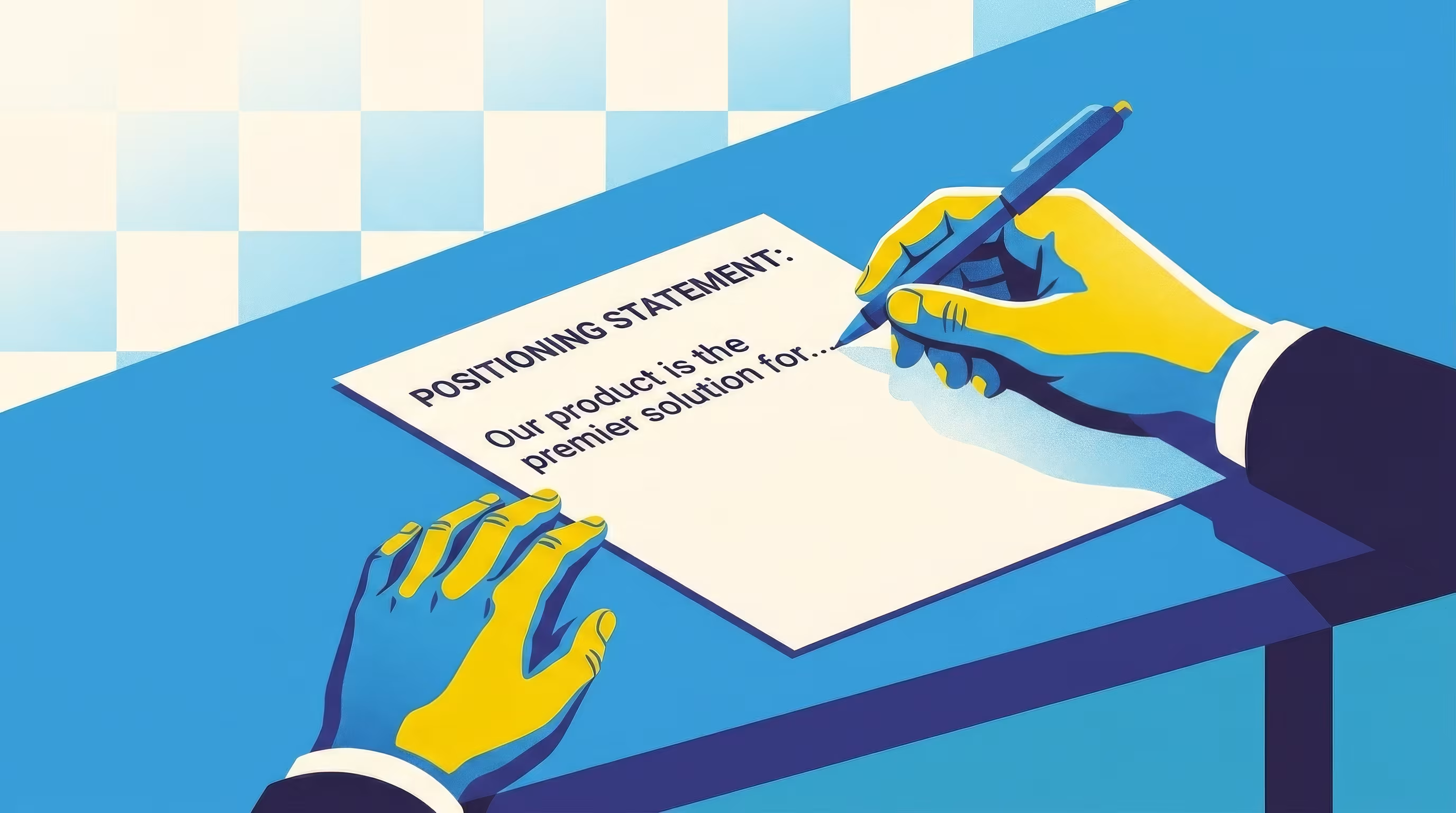
Here is what we see most often: a founder who intellectually understands their positioning but hasn't written it down clearly enough for anyone else to use.
It exists in their head. They can articulate it when they're in the room. But their sales team tells a different story. Their marketing copy says something else. Their website says a third thing.
Writing the positioning statement forces a kind of precision that the mind alone cannot maintain. It makes the implicit explicit. And once it's explicit, it can be shared, debated, refined, and used consistently across every person and every channel.
The discipline of writing it down is not a formality. It is the work.
(Understanding the difference between positioning, identity, and strategy helps clarify what comes next: Brand positioning vs. brand identity vs. brand strategy)
(If you want a framework to build this for your brand, the full process is in Stop Being Forgettable →)
After the statement
A positioning statement isn't the endpoint. It's the starting point.
Once you have it, every subsequent decision in your company should be able to trace itself back to it. Hiring decisions, product roadmap priorities, campaign messages, visual language. The positioning statement is the test every other decision must pass.
If something in your brand or business can't be justified by your positioning, that's important information. Either the decision is wrong, or the positioning needs to be updated. Either way, the statement creates accountability that most companies don't have.
That accountability, the ability to say "this is who we are and therefore this is what we do," is the foundation of every great brand.
Become™ is a Brand & Product Design Consultancy, headquartered in India and working with global brands including Fortune 500 companies. We work with growth-stage companies and IPO-ready businesses to build the positioning that drives revenue growth, market share, and category leadership. Start the conversation at become.team.
Or save this article as a PDF for future research, workshops and strategy sessions
.avif)
.avif)
.avif)






.svg)